FIELD NOTES
To Swab or Not to Swab?
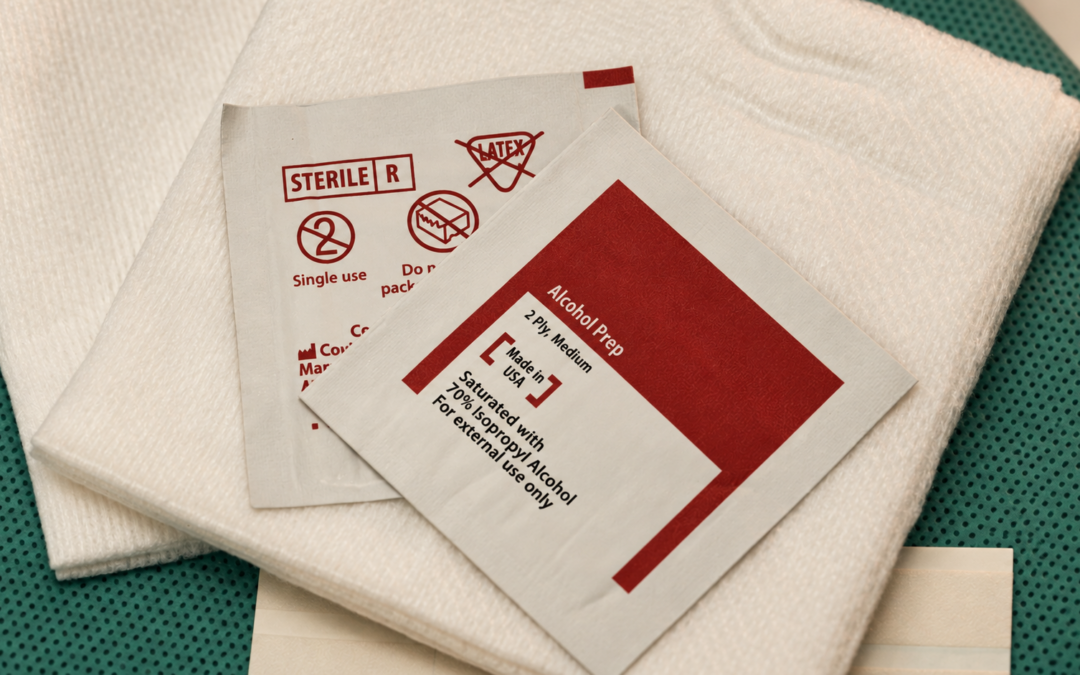
An alcohol wipe sent me down a rabbit hole.
Recently, I treated a patient and didn’t swab every acupuncture point with alcohol before inserting the needles. She mentioned that she would have preferred that I did.
A perfectly reasonable preference, and one I very much respect. But I’ve been thinking about it ever since.
Throughout my acupuncture education, I’ve encountered different approaches to skin preparation. I had learned that routine alcohol swabbing of visibly clean skin wasn’t universally considered necessary, but I realized I hadn’t investigated the evidence as thoroughly as I wanted to. I had some questions, and apparently, an alcohol wipe was about to become my latest research obsession.
So I went digging.
What does the science actually say?
Alcohol is effective at reducing bacteria on the skin. That’s well established. What is less clear is whether routinely swabbing already-clean skin before acupuncture meaningfully reduces the risk of infection.
One of the more interesting things I came across was a 2020 review by the Canadian Agency for Drugs and Technologies in Health (CADTH). It examined the evidence and guidelines surrounding skin preparation before injections and vaccinations, and I was surprised to discover how much the recommendations differed.
The World Health Organization, along with health authorities in the United Kingdom and Australia, had issued guidance indicating that alcohol swabbing wasn’t necessary before certain routine injections when the skin was visibly clean. Meanwhile, the Public Health Agency of Canada recommended cleaning the skin with an appropriate antiseptic.
These are respected public health organizations looking at similar questions and arriving at different recommendations.
The review also examined a randomized controlled trial comparing vaccinations performed with and without alcohol swabbing. Researchers found no significant difference in several local skin reactions, and no infections were observed in either group. However, the study wasn’t large enough to reliably determine whether swabbing prevents rare infections.
Of course, a vaccination isn’t the same procedure as acupuncture. We can’t automatically transfer those findings from one procedure to another. But it did make me curious about how much of our routine clinical practice is supported by research measuring actual patient outcomes, and how much is based on reasonable precautions that haven’t necessarily been studied in isolation.
What about acupuncture specifically?
This is where things became even more interesting.
The Clean Needle Technique manual recommends alcohol swabbing, but acknowledges that antiseptic preparation may not be essential when the skin is already clean. A position paper from the Council of Colleges of Acupuncture and Herbal Medicine also recognizes that we lack direct comparative studies establishing whether routine swabbing reduces acupuncture-related infections.
Meanwhile, Acupuncture Canada recommends antiseptic skin preparation as an additional precaution.
I also looked into the broader research on acupuncture safety. A 2021 systematic review published in BMJ Open found that serious adverse events associated with acupuncture were rare, although the estimates varied considerably between studies.
That’s reassuring, but there’s an important distinction. Most acupuncture safety research examines treatments as they’re normally performed, with whatever infection-control practices the practitioners were using. It doesn’t isolate alcohol swabbing to determine how much that particular step contributes to preventing infection.
A low rate of infection doesn’t prove that swabbing is unnecessary, just as a lack of evidence demonstrating its benefit doesn’t prove that it has no benefit.
And that distinction is probably the most useful thing I’ve taken away from all this reading.
The little details that sent me further down the rabbit hole
Once I started looking into skin preparation, I found myself wondering about the practical details of how we actually perform acupuncture.
For example, does every individual acupuncture point need its own alcohol wipe? Can several nearby points be prepared together? What happens when we disinfect an area and then touch the skin again to palpate and locate the point before inserting the needle?
An acupuncture treatment room isn’t a sterile environment, nor is the patient’s skin ever completely sterile. We use sterile, single-use needles, maintain clean treatment surfaces, practise hand hygiene, and follow clean needle technique, but there’s an entire sequence of small decisions between preparing the skin and inserting a needle.
Alcohol needs sufficient contact time and must be allowed to dry. The skin can also be contaminated again after preparation, depending on what touches it. It made me realize that the way we perform skin preparation matters just as much as whether we perform it.
And then there’s facial acupuncture, which adds another layer to the discussion. Facial skin can be particularly sensitive, especially when someone is experiencing dryness, irritation, or a compromised skin barrier. Alcohol can be drying, and facial acupuncture often involves numerous fine needles across relatively delicate areas. It’s made me curious about best practices for skin preparation during facial treatments, including how to balance effective infection prevention with protecting the skin barrier. That’s another rabbit hole I’d like to explore.
During my reading, I also came across a 2021 study published in PLOS ONE in which researchers interviewed infection-control nurses in Japan about their reasoning around skin disinfection before subcutaneous injections. They explored how established hospital protocols, professional habits, and concerns about infection influenced clinical decisions.
The study didn’t measure infection rates, so it couldn’t tell us whether swabbing was necessary. What I found fascinating was its exploration of how healthcare practices become established and why they can persist even when the evidence is uncertain.
Clinical practice is influenced by research, professional standards, experience, training, and longstanding routines. Those things don’t always line up as neatly as we might expect.
And then there’s the patient
Somewhere in the middle of reading all these papers, I kept coming back to the reason I’d started investigating in the first place.
Interestingly, I’ve also treated someone who expressed concern about being particularly susceptible to infection. During that appointment, I carefully prepared each acupuncture point individually with alcohol. It felt appropriate to take extra care in response to their concerns.
These two experiences have had me thinking about how differently people can experience the same clinical procedure, and how important it is to listen.
I’ve also had patients who preferred a more thorough approach to skin preparation, and I’ve been happy to accommodate those preferences when clinically appropriate. It’s something I’ve always considered on an individual basis, but these experiences have made me think more carefully about what my standard approach should be, regardless of whether a patient specifically requests it.
Of course, infection-control decisions need to be grounded in clinical risk and professional standards, not simply individual preference. But patient comfort and communication belong in that process too.
I practise in New Brunswick, where acupuncture isn’t provincially regulated, and I take the responsibility of maintaining strong professional standards seriously. I don’t want to make clinical decisions simply because something is or isn’t legally required. I want to understand the reasoning behind what I do, follow appropriate infection-control practices, and give my patients confidence in the care they’re receiving.
And sometimes that means reconsidering a habit, even when the original reasoning behind it wasn’t entirely unreasonable.
Where I’ve landed
After all this reading, I’ve decided to be more consistent about alcohol skin preparation. I’m also interested in exploring best practices for facial acupuncture, where the condition and sensitivity of the skin deserve particular consideration.
The research hasn’t answered every question I have, and I’m sure I’ll keep exploring the details. But routine skin preparation is a reasonable precaution that aligns with Canadian professional recommendations, and I’m comfortable making that part of my practice.
I’m glad my patient said something. It encouraged me to look more closely at a clinical decision I’d previously taken for granted.
One thing I’m discovering about becoming a practitioner is that having actual patients in front of me makes me more curious than ever. There’s so much to learn beyond the textbooks, and sometimes the most useful lessons come from the smallest moments in the treatment room.
This week’s rabbit hole started with a tiny alcohol wipe.
And now I’ve got a small collection of research papers about skin disinfection.
Naturally.
— Field Notes from Lacey Park
Research & References
Acupuncture Canada. (2017). Recommendations for Skin Preparation.
Bäumler P, et al. (2021). Acupuncture-related adverse events: systematic review and meta-analyses of prospective clinical studies. BMJ Open. https://doi.org/10.1136/bmjopen-2020-045961
Canadian Agency for Drugs and Technologies in Health. (2020). Skin Preparation for Injections: A Review of Clinical Effectiveness, Cost-Effectiveness and Guidelines. https://www.ncbi.nlm.nih.gov/books/NBK562932/
Wong H, et al. (2019). Effect of alcohol skin cleansing on vaccination-associated infections and local skin reactions: a randomized controlled trial. Human Vaccines & Immunotherapeutics. https://pmc.ncbi.nlm.nih.gov/articles/PMC6605859/
Yoshida Y, et al. (2021). Is skin disinfection before subcutaneous injection necessary? The reasoning of Certified Nurses in Infection Control in Japan. PLOS ONE. https://pmc.ncbi.nlm.nih.gov/articles/PMC7794031/
Council of Colleges of Acupuncture and Herbal Medicine. Position Paper on Skin Preparation Prior to Acupuncture Needle Insertion.