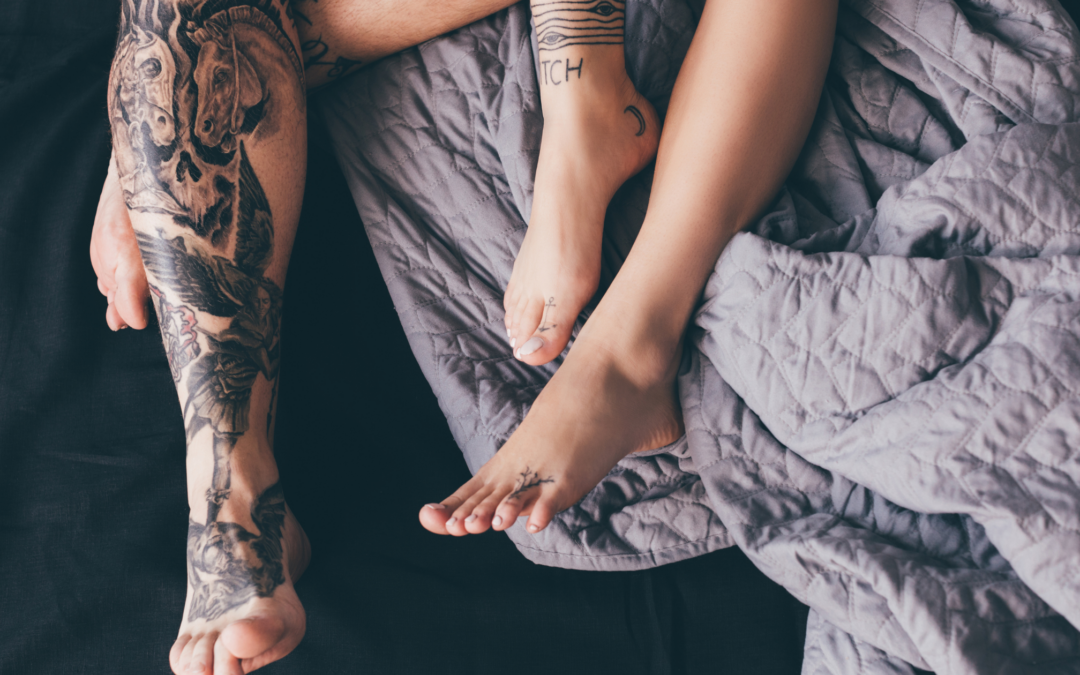
Last weekend I spent a couple of days at the Halifax Body Art Convention with my acu-bestie, Julie Tattrie-Johnson of Needle Little Healing.
It was one of those weekends where everything just came together.
My family got tattooed, I added two new pieces, I kept running into classmates from CCATCM, and we ate our way around downtown between tattoo appointments. Sketti & Ball Co. and Antojo Tacos + Tequila definitely lived up to the hype. The weather was unbelievably hot, the city was buzzing, and we had an amazing time.
I came home limping with two fresh tattoos, a swollen calf, and yet another reminder that once you start studying Traditional Chinese Medicine, you begin looking at everything a little differently.
A tattoo isn’t just body art anymore.
It’s controlled trauma. It’s an inflammatory response. It’s wound healing. It’s Qi and Blood in motion.
It also reminded me how many myths about tattoos and Chinese medicine are circulating on social media.
Spend five minutes on TikTok or Instagram and you’ll probably find someone confidently explaining that tattoos permanently block meridians, trap Qi, damage organs, or create energetic imbalances that can never be corrected.
As someone who studies Traditional Chinese Medicine, loves tattoos, and spent the next several days watching my own body heal, I thought it would be interesting to separate what the classical texts actually say from the modern interpretations that seem to have taken on a life of their own.
Tattoos aren’t especially common in China
One thing I noticed when I visited China is that tattoos are still much less common in China than they are here in North America.
There are good reasons for that, but they’re often cultural rather than medical.
Historically, many Chinese philosophies viewed the body as a gift inherited from one’s parents that should be treated with respect and preserved. Tattoos have also carried different meanings throughout Chinese history, at times being associated with punishment or criminality.
That doesn’t mean Traditional Chinese Medicine teaches that tattoos are unhealthy.
It reminds us that culture and medicine are not always the same thing.
Sometimes social media blends the two together until it’s difficult to tell where one ends and the other begins.
Do tattoos block Qi?
This is probably the most common claim I see online.
The idea is that because tattoo needles repeatedly penetrate the skin, they permanently interrupt the flow of Qi through the meridians beneath them.
The problem is that I haven’t found evidence for this in the classical literature.
Ancient Chinese physicians wrote extensively about trauma, burns, wounds, scars, surgery, and skin disease. They clearly recognized that injuries could temporarily affect the movement of Qi and Blood while tissues were actively healing.
A fresh tattoo certainly fits into that conversation.
A healed tattoo is another matter.
As far as I can tell, there isn’t a classical source that says decorative tattoos create permanent energetic blockages simply because pigment exists in the skin.
That doesn’t mean tattoos have no effect on the body.
It means we should be careful about presenting modern interpretations as ancient teachings.
What about tattoo ink in the lymph nodes?
Another argument I see is that tattoo ink has been found in lymph nodes, therefore tattoos must be harmful from a Traditional Chinese Medicine perspective.
The first part is true.
Research has shown that tiny particles of tattoo pigment can be carried by immune cells to nearby lymph nodes. Macrophages (cells responsible for cleaning up debris and foreign material) engulf some of the pigment during the healing process. Most of the ink stays in the skin, giving the tattoo its colour, but a small amount can migrate to regional lymph nodes.
From a biomedical perspective, this isn’t necessarily a sign that something has gone wrong. It’s part of the body’s normal response to tattooing.
From a TCM perspective, I don’t think this proves tattoos block Qi.
What it does remind me of is that Chinese medicine has always paid close attention to the body’s defensive functions and the movement of fluids. Those concepts don’t map perfectly onto the modern lymphatic system, but it’s an interesting area to think about.
If I were looking at this through a TCM lens, I might wonder whether the healing process temporarily places extra demands on Qi, Blood, Body Fluids, and Wei Qi. After all, your body has just experienced thousands of tiny punctures and immediately begins repairing tissue.
That’s a very different statement from saying tattoo ink causes permanent energetic obstruction.
At this point, I don’t think we have evidence to make that leap.
Scar tissue is a much more interesting conversation
If there’s one area where I think Traditional Chinese Medicine has something meaningful to contribute, it’s scar tissue.
TCM has always recognized that scars from surgery, burns, injuries, and trauma can affect the local movement of Qi and Blood.
That doesn’t mean every scar becomes a problem.
Most don’t.
But when scar tissue becomes thick, fibrotic, painful, or restrictive, it’s something we assess.
I once treated a patient whose tattoos had developed extensive scar tissue. The artwork itself wasn’t concerning. It was the raised, dense tissue that caught my attention.
Looking at it through a TCM lens, it’s easy to imagine how that kind of tissue could contribute to local Qi and Blood stagnation. Interestingly, that’s not very different from how many physiotherapists, massage therapists, and other manual therapists think about dense scar tissue affecting movement and surrounding tissues.
Again, this isn’t an argument against tattoos.
It’s an argument for healing well.
The question isn’t whether someone has tattoos.
The more interesting question is how their body responded.
My own accidental case study
My own tattoos gave me a chance to think about this in real time.
My calf tattoo was a different experience from my forearm.
The artist worked incredibly quickly and packed in a lot of ink. By the end, my lower leg was impressively swollen. My foot even started feeling strange from the amount of swelling.
So I did what every acupuncture student eventually does.
I turned myself into a pin cushion.
I treated the opposite leg with acupuncture, choosing points to move Qi and Blood, reduce swelling, and support my body’s healing response.
Within a surprisingly short time (before I even had the fifth needle in), the swelling started settling down and my foot felt noticeably more normal.
Would it have improved without acupuncture?
Probably.
Healthy bodies are designed to heal.
But reducing inflammation, improving circulation, and supporting recovery are exactly the kinds of things people commonly seek acupuncture for after injuries and surgery, so using it here made perfect sense to me.
The part I found most interesting came afterward.
By the next day, my forearm tattoo barely hurt.
By days three and four, both tattoos were healing beautifully. The swelling had largely resolved, there were no signs of infection, and the colours looked fantastic.
To me, that reflects something TCM has always valued: healthy function.
Good circulation.
Healthy Qi.
Healthy Blood.
A body that’s capable of repairing itself efficiently.
Curiosity over certainty
One of the biggest lessons Traditional Chinese Medicine has taught me is to become comfortable saying, “I’m not sure.”
Social media rewards certainty.
It rewards the person confidently pointing at a tattoo and declaring they’ve permanently damaged their Liver meridian.
Real medicine is usually quieter than that.
It asks better questions.
It observes.
It changes its mind when new evidence appears.
My tattoos haven’t made me question Traditional Chinese Medicine.
If anything, they’ve reminded me why I was drawn to it in the first place.
At its best, TCM isn’t about fear. It isn’t about superstition. And it certainly isn’t about making absolute claims because they get clicks.
It’s about paying attention to the body in front of you.
Sometimes the most interesting thing you can say as a practitioner isn’t, “I know exactly what’s happening.”
Sometimes it’s, “That’s interesting… let’s see what the body does next.”