This presentation came out of one of those moments in school where everything starts to click.
Not in a dramatic, lightbulb way, more like… you’re sitting there looking at a pattern you’ve heard about a hundred times, and suddenly you can see it in real women, real cycles, real pain.
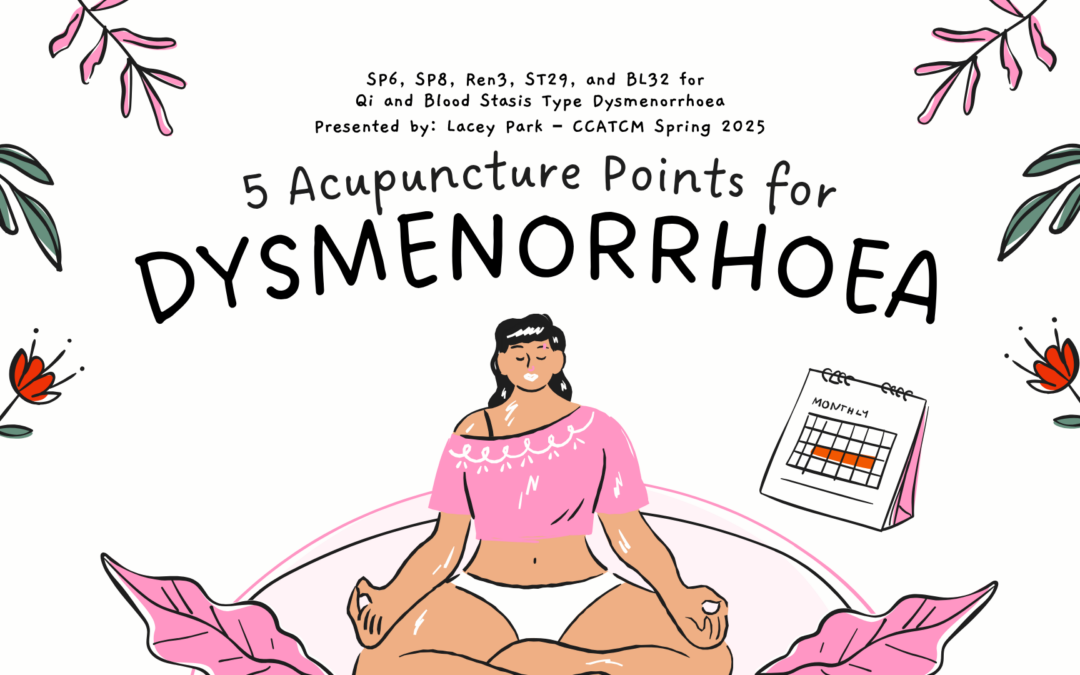
This one was for my a Acupuncture Points Class in Spring 2025 and I chose to focus on dysmenorrhea, painful periods, specifically the Qi and Blood stasis pattern. It’s one of the most common patterns we see, especially in younger women or women who are holding a lot, stress, tension, things that don’t get expressed.
Because in Chinese medicine, we don’t just say “you have cramps.”
We ask, what is actually happening in the body that would make it hurt like that?
And one of the clearest answers is this:
When Qi doesn’t move, Blood can’t move.
And when Blood doesn’t move, pain happens.
Sharp, stabbing, fixed pain.
Clots.
That feeling of pressure building before your period starts.
That’s Qi and Blood stasis
What fascinated me most
What I love about this system is how precise it is without being complicated.
In Western terms, you might be told your hormones are “off” or given something to manage the pain. But here, we’re looking at movement, warmth, flow, and asking where things are getting stuck.
And it’s rarely just physical.
Emotional stress, frustration, lack of movement, even digestion all play into this pattern
Which makes sense when you actually think about real life.
Women holding it together.
Not saying what needs to be said.
Pushing through.
Sitting more than moving.
Running on coffee and whatever’s quick.
Of course things get stuck.
The 5 point treatment that ties it all together
For this presentation, I built a simple five point protocol that works both at the root and right where the pain is happening.
You’ll see it in the slides, but here’s the feeling of it in plain language:
SP6 is the anchor. It brings together the Spleen, Liver, and Kidney, the systems that build, move, and store Blood. It’s one of those points that just… stabilizes everything.
SP8 is more direct. It’s used for acute pain. When things feel intense and immediate, this is one of the places we go to move stagnation quickly.
Ren3 and ST29 work locally in the lower abdomen. This is where we’re warming, opening, and actually creating space for things to move again.
And then BL32, which I love for this pattern, especially when pain wraps into the low back. It works through the sacrum to open the entire pelvic area and relieve that deep, aching tension.
Together, they’re not random.
They’re a conversation inside the body.
Build what’s weak.
Move what’s stuck.
Warm what’s cold.
Open what’s closed.
And yes, there’s research behind it
One of the things I wanted to include in this project was modern research, not to prove something ancient is valid, but to show that we’re starting to measure what practitioners have been seeing for a long time.
One study with 200 women showed a significant reduction in pain within 60 minutes of treatment using points like the ones in this protocol
Another compared electro-acupuncture to common medications and found equal or better results, with fewer side effects over time
That matters.
Not because acupuncture needs validation, but because women deserve options that don’t come with a long list of trade-offs.
Why I wanted to share this
This wasn’t just a school assignment for me.
It was one of those pieces of work that made me feel more confident in what I’m doing and where I’m going with this medicine.
Because when you understand the “why” behind something like period pain, it stops feeling random.
It becomes something you can actually work with.
Something you can change.
And that’s the whole point of this work.
Not just managing symptoms, but helping the body come back into a place where things flow the way they’re meant to.
Lacey Park – Acupuncture for Dysmenorrhea: Focus on Qi and Blood Stasis Pattern