If you’ve ever wished your skin could glow again, not from filters or fillers, but from something that actually feels good in your body, cosmetic acupuncture might surprise you.
This isn’t a new trend. It’s a modern revival of a centuries-old practice that uses the same principles as Traditional Chinese Medicine (TCM): balance, circulation, nourishment, and vitality.
What’s new is that science is finally catching up and showing us why it works.
Collagen Induction: The Body’s Natural Repair System
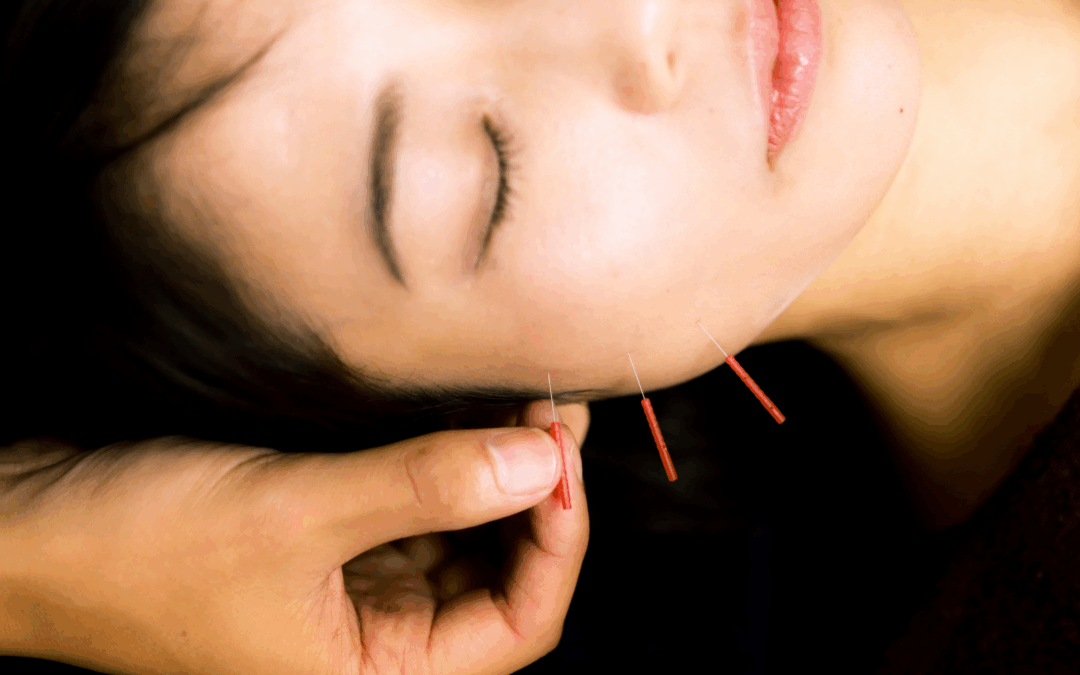
When fine needles are inserted into the face, they create microscopic “injuries” that trigger the skin’s natural healing cascade. Fibroblast cells rush in to repair tissue, producing collagen and elastin — the proteins that keep skin firm, smooth, and supple.
A pilot study published in the Journal of Acupuncture and Meridian Studies found that women aged 40–59 experienced measurable improvements in facial elasticity after just five sessions of facial cosmetic acupuncture (Yun et al., 2013). Using Moiré topography imaging, researchers documented smoother texture and tighter skin — confirming what many practitioners already see in clinic.
Other studies echo this mechanism: local needling increases growth factors such as VEGF (vascular endothelial growth factor) and TGF-β (transforming growth factor beta), which encourage new collagen networks to form.
In simpler terms:
Cosmetic acupuncture acts as a natural form of collagen induction therapy — no machines, no chemicals, just your body doing what it’s designed to do.
Neuromuscular Reset: Lifting from the Inside Out
Under the surface, your face isn’t just skin — it’s a landscape of muscles, fascia, and connective tissue. Over time, some muscles become overactive (hello, frown lines), while others weaken (causing droop or laxity).
Facial acupuncture works by rebalancing these neuromuscular patterns. Tiny needles stimulate motor points and nerve endings, gently re-educating the muscles to relax or activate as needed.
A 2025 randomized controlled trial reported that facial and body acupuncture together significantly reduced glabellar (frown) lines in women aged 30–59 compared with a control group (Lee et al., 2025). Participants also reported higher satisfaction and a sense of overall well-being — a reminder that this treatment supports both outer appearance and inner balance.
TCM would describe this as “moving Qi and Blood to the face” — when energy flows freely, structure and tone follow naturally.
Circulation, Lymph Flow & Radiance
Healthy skin is well-circulated skin. Each needle triggers a local axon reflex, leading to vasodilation — or widening — of small blood vessels. The result? Better oxygen and nutrient delivery to the skin, faster removal of cellular waste, and improved lymphatic drainage.
This increased microcirculation is why people often leave a treatment looking instantly brighter. It’s not “redness”; it’s fresh oxygen and Qi moving through the tissues.
A review in the Journal of Cosmetic Medicine notes that facial acupuncture can increase skin hydration, elasticity, and overall tone through improved blood and lymph flow (Kim et al., 2018).
In TCM terms, we would say:
“When Qi and Blood are abundant, the complexion is luminous.”
Anti-Inflammatory & Hormonal Support
Here’s where cosmetic acupuncture goes far beyond surface beauty.
Because treatments often include body points as well as facial ones, they engage the entire body’s self-regulation systems — especially the hypothalamic-pituitary-adrenal (HPA) axis, which governs stress and hormonal balance.
Multiple studies have shown that acupuncture can:
- Lower cortisol (stress hormone) levels
- Modulate inflammatory cytokines like IL-1β and TNF-α
- Increase anti-inflammatory mediators such as IL-10
- Improve skin barrier function and circulatory homeostasis
For example, a review published in Cosmetics (MDPI) highlights how acupuncture down-regulates inflammatory pathways and oxidative stress in the skin, helping restore its natural defense systems (Zhang et al., 2020).
That’s why it’s so effective for rosacea, acne, eczema, or stress-related flare-ups — and why it supports perimenopausal or postpartum women whose hormones are in flux.
TCM View: Beauty Rooted in Balance
Traditional Chinese Medicine doesn’t separate beauty from health. The skin is seen as an external reflection of the internal landscape, the harmony of Qi, Blood, Yin, and Yang.
Facial rejuvenation acupuncture often includes body points that address underlying imbalances such as:
- Spleen Qi deficiency (loss of tone and puffiness)
- Liver Qi stagnation (tension and wrinkles between the brows)
- Kidney Yin deficiency (dryness, fine lines, premature aging)
By treating both the root (internal systems) and the branch (the face), results are longer-lasting and more holistic.
In other words: glowing skin is not just a cosmetic outcome, it’s a sign of internal balance.
What the Research Shows (and What We Still Need)
Scientific interest in cosmetic acupuncture has grown rapidly, though studies are still limited by small sample sizes and varied protocols.
Here’s what’s been published so far:
- Improved elasticity and tone: Yun et al., 2013 (Journal of Acupuncture and Meridian Studies)
- Reduced wrinkle depth and muscle tone rebalancing: Lee et al., 2025 (Integrative Medicine Research)
- Increased hydration and collagen density: Kim et al., 2018 (Journal of Cosmetic Medicine)
- Melasma improvement: Rerksuppaphol et al., 2016 (Journal of Cosmetic Dermatology)
- Facial muscle rejuvenation with Jae-Seng technique: Cho et al., 2015 (Evidence-Based Complementary and Alternative Medicine)
Systematic reviews, such as the one summarized by ScholarsWorks Walden University (2019), conclude that results are promising (especially for elasticity, wrinkles, and muscle tone) but call for larger randomized controlled trials to standardize protocols and verify long-term outcomes.
What to Expect in a Cosmetic Acupuncture Session
Every treatment begins with a full TCM assessment, not just of your face, but your digestion, sleep, energy, and menstrual health.
Then, ultra-fine needles are gently inserted in specific areas of the face and body to:
- Stimulate collagen and circulation
- Release muscle tension
- Improve lymphatic flow
- Support internal organ balance
Sessions typically last about 90 minutes from start to finish, and a full course often involves 8-12 treatments, depending on age and health. You can expect to see subtle lift and brightness after 1–2 visits, with more significant tone and texture improvements building over time.
Clients often describe feeling deeply relaxed and rejuvenated, not just in their skin, but in their whole nervous system.
Why It Resonates with Holistic, Real Life Women
For women who value natural health, resilience, and connection to their bodies, cosmetic acupuncture feels like a breath of fresh air.
You’re not fighting aging, you’re partnering with it. You’re using time-tested medicine to support your body’s own ability to regenerate.
And for those of us living closer to the land, off-grid, or simply tired of the beauty industry’s noise, this is the kind of medicine that fits.
It’s slow, intentional, and deeply personal, much like the rest of your healing journey.
Bringing It Home
As both an acupuncture student in Halifax (2025–2026) and a future practitioner in Carleton County, NB, I’m building a practice that blends science, spirit, and soil, where wellness feels grounded, not performative.
Cosmetic acupuncture will be one of the offerings in my future clinic, alongside women’s health acupuncture, postpartum recovery, and Traditional Chinese dietary therapy.
Because true radiance isn’t just about looking well, it’s about being well.
A Gentle Note: I’m a student of Traditional Chinese Medicine, and this space reflects my learning as it unfolds. TCM is deep, layered, and complex, and I’m still finding my footing within it. I will refine my understanding over time. I will make mistakes. That’s part of doing this honestly. What I share here is my current perspective, shaped by my teachers, clinical training, lived experience, and my own biases. It’s not absolute, it’s evolving. I welcome thoughtful conversation, shared insight, and respectful correction along the way. I humbly welcome your insight. Let’s learn together. You can always find me over on Instagram to keep the conversation going.